

 ×
×
A 7-axis ground rail welding robot system integrates a motorized 7th axis (a high-precision linear ground rail) beneath a standard 6-axis articulated robotic arm. By extending the operational radius from a conventional 2–3 meters to over 10–30 meters, it solves the section gap and quality inconsistency issues typical of manual and standard robotic welding on extra-long workpieces (e.g., structural steel beams, crane booms, and railcar underframes). Suitable for steel components with open top or side access at the welding position, with plate thickness on one side from 6 mm to 30 mm. Featuring multi-station synchronization and high-precision multi-axis motion, this system boosts welding efficiency by 50-80%, serving as a high-ROI core asset for heavy manufacturing automation.
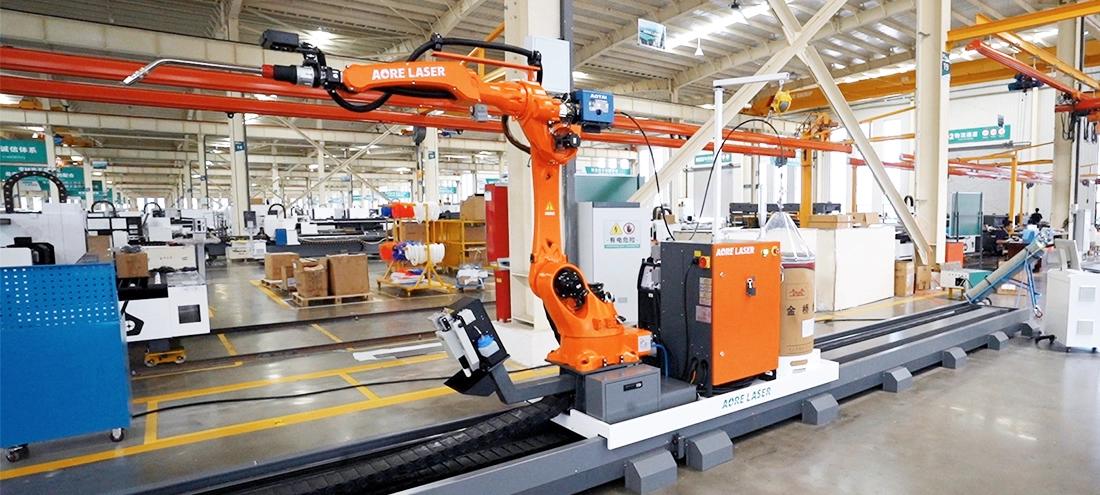
In modern industrial automation, standard 6-axis articulated welding robots offer high maneuverability, but their working envelope is strictly limited by arm reach (typically between 1.4 m and 3.1 m). When fabricating oversized or elongated heavy components, a single 6-axis robot cannot cover the entire weld path in a single setup.
The 7-axis ground rail welding robot system (also known as a ground-mounted 7th-axis linear track system) overcomes this reach limitation. It consists of four integrated modules:
6-Axis Articulated Robot Arm: Handles torch orientation, complex seam fitting, and precise micro-trajectory control.
Ground 7th Axis (Linear Track System): Serves as the mobile base for the robot. Built with a high-rigidity welded steel bed, precision linear guide rails, and a heavy-duty rack-and-pinion drive, it enables long-span translation along the X-axis.
Welding & Execution Package: Integrates a high-performance welding power supply (MIG/MAG, TIG, or Laser/Hybrid), an automated torch-cleaning and wire-cutting station, and a water-cooled torch.
Central Master Controller: Supports 3D CAD model importing and offline programming (OLP). The controller automatically generates toolpaths, extracts weld seams, and matches process parameters with a single click. Real-time arc tracking ensures weld consistency while allowing flexible operator deployment.
Traditional methods for workpieces over 10 meters long rely on manual repositioning or multiple fixed robots, causing weld defects such as arc interruptions, slag inclusions, and lack of fusion at section joints. A 7-axis weld machine offers customizable track lengths to match facility dimensions, enabling continuous, single-pass welds on oversized structures.
To maximize equipment utilization, the system accommodates multiple workpieces simultaneously in a single setup, generating weld paths instantly for uninterrupted processing:
Sequential Station Allocation: Divides the linear rail length into 2–4 independent workzones (Station A, Station B, Station C).
Parallel Efficiency: While the robot welds automatically at Station A, the operator loads, aligns, and clamps the next component at Station B.
Zero Machine Downtime: Eliminates idle waiting time during manual loading and unloading, elevating Overall Equipment Effectiveness (OEE) to over 85%.
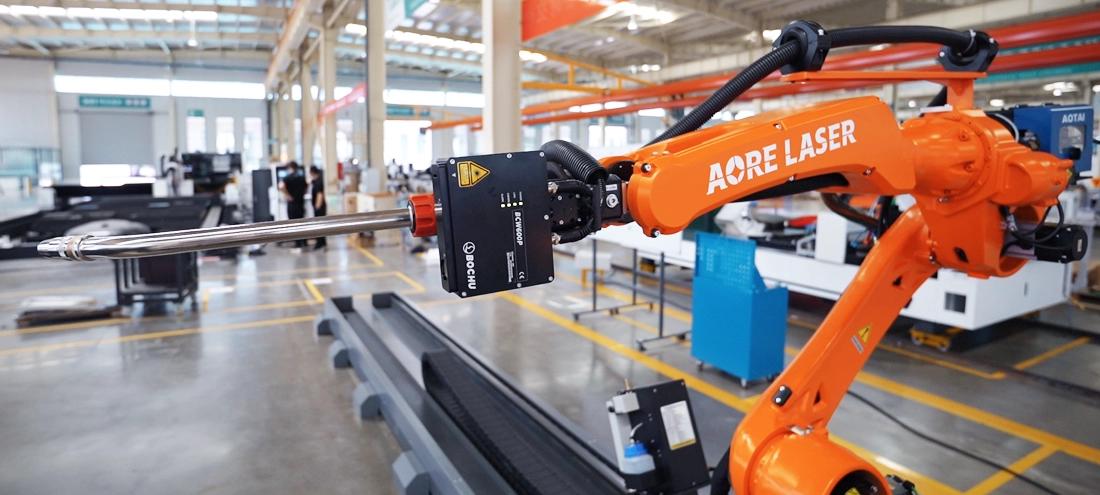
Fit-Up Tolerance Adaptability: Precision tracking handles assembly tolerances up to ±25 mm. Multiple scanning modes adapt to diverse joint geometries (butt, lap, fillet, etc.).
Travel Speed: 40m/min
Repeatability: Within ±0.05 mm to ±0.1 mm.
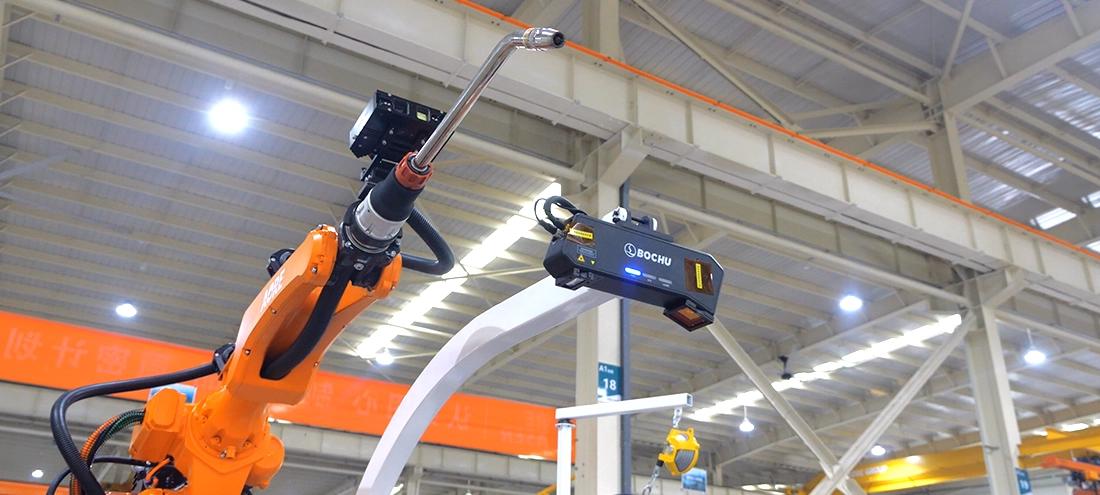
Aore Laser A-W7 intelligent workstation is equipped with Bochu'steach-free welding system and Bochu's large-field-of-viewseam seeker. It directly imports 3D model files from Tekla, SOLIDWORKS, or UG, matches welding process parameters, automatically identifies the precise weld position, and generates the optimized welding process for execution. The floor-track type traveling axis increases adaptability to the workpiece length, and the robot can work in coordination with the track to weld long seams in a single pass.
A reinforced reducer with a high reduction ratio design improves control precision.
Hollow structure on Axis 4 uses double angular contact bearings instead of conventional structures, enhancing joint support rigidity.
Axes 4 and 6 are equipped with dedicated gear backlash adjustment mechanisms for higher joint accuracy.
Wrist redesigned into a U-shaped structure for improved rigidity.
Special noise-reduction structure on the wrist ensures lower operating noise.
The above features significantly improve the motion stability of the extended-reach welding robot, while the shortened wrist enhances flexibility.
A: Yes. The 7th axis operates as a fully synchronized servo axis. The master controller automatically adjusts travel speeds so the welding torch maintains a constant speed and angle relative to the joint, even while moving along the rail.
A: High-quality A-W7 welding robots using helical rack-and-pinion drives and linear guides offer a repeatability of ±0.05 mm, which fully satisfies strict industrial welding standards.
A: 7-axis welding robots are simpler to install, cost less, and offer high stability. Overhead gantries are preferred when floor space is tight or when heavy overhead cranes need unobstructed floor access.
A 7-axis welding robot system solves the physical reach limits of standard industrial robots. By combining a 6-axis arm with a long-travel linear base, heavy fabricators can achieve consistent weld quality, reduce labor dependency, and significantly increase daily production output.